

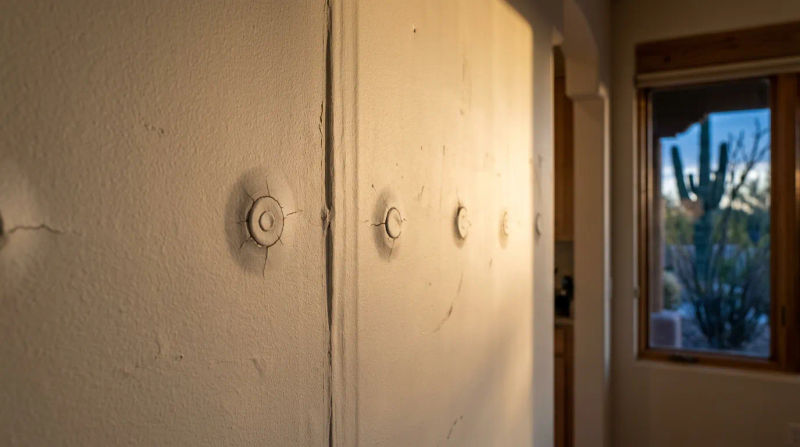
You’re relaxing in your living room as the sun sets over the Tortolita Mountains. The evening lamp casts a low, raking light across the wall, and suddenly you see it: a small, perfectly round bump that wasn't there before. When you touch it, you can feel the distinct outline of a nail or screw head just beneath the paint. It’s a classic case of a drywall nail pop, a common sight for homeowners. But is it just a minor cosmetic flaw, or is it a sign of a bigger problem?
As a project superintendent with over a decade of experience in the Tucson area, I’ve seen this exact scenario play out in countless homes. Especially here in Saddlebrooke, our unique climate can play tricks on a home’s building materials. While a single pop might be nothing to worry about, a pattern of them - or other related signs - can tell a story about what’s happening within your walls. Let’s look at the signs, understand the causes, and determine when it’s time to call in a professional.
Common Signs and Symptoms
Identifying drywall issues goes beyond spotting a single popped nail. When our technicians perform an assessment, we look for a range of symptoms that provide clues to the underlying cause. Keep an eye out for these signs in your home:
- Drywall Nail Pops: These are the most common and obvious signs. They appear as small, raised circles on your walls or ceilings, sometimes with the paint cracked around the edges. They are the heads of nails or screws that have been pushed outward from the framing lumber behind the drywall.
- Ceiling Drywall Screw Pops: When these appear on your ceiling, they deserve a bit more attention. Gravity is a constant force, and multiple ceiling drywall screw pops could indicate that the fasteners are no longer providing adequate support for the heavy drywall sheet. You might notice them more in large, open-concept rooms, which are a hallmark of the homes built in Saddlebrooke during the 1990s and 2000s.
- Drywall Tape Bubbling Signs: Look closely at the seams where sheets of drywall meet. Do you see long, blister-like bubbles or areas where the paper tape is peeling away from the wall? These drywall tape bubbling signs indicate a failure in the joint compound's adhesion, which can be caused by movement or, in some cases, moisture.
- Ridges and Seams: Sometimes, instead of a pop, you’ll see a faint but visible vertical or horizontal line where two drywall panels meet. This seam, which should be invisible, can become prominent as the framing behind it moves.
- Corner Cracks: Hairline cracks that appear in the corners where walls meet or where walls meet the ceiling are often related to structural movement. You may also see them radiating from the corners of window and door frames.
What Causes This Problem
Understanding why these issues occur is key to finding the right solution. While it’s easy to blame “settling,” the real culprits, especially for nail pops in drywall Saddlebrooke homes, are often environmental and structural.
1. Lumber Movement and Climate: The primary cause of most drywall nail pops is the natural movement of the wood framing inside your walls. Framing lumber shrinks as it dries out over time. Here in Southern Arizona, the extremely dry air accelerates this process. Furthermore, the significant temperature swings between our warm days and cool nights - especially in October when we can get our first freezing nights - cause the wood to expand and contract. This constant, subtle movement can slowly but surely push nails and screws outward, making them visible.
2. Truss Uplift: This is a common phenomenon in homes with engineered roof trusses, prevalent in the single-level floor plans of the Saddlebrooke area. In the winter, the bottom chords of the trusses (in your warm attic) stay at a different temperature and moisture level than the top chords exposed to the cold. This differential causes the truss to bow upward slightly, lifting the ceiling drywall with it. This movement often creates a crack along the seam where the ceiling meets the interior walls.
3. Initial Settling vs. Ongoing Movement: Most homes in Saddlebrooke, built predominantly in the 1990s and 2000s, are well past their initial foundation settling period. If you’re seeing new pops and cracks appearing now, it’s more likely due to the ongoing seasonal expansion and contraction of building materials rather than the house “settling.”
4. Moisture Issues: While less common, bubbling tape can be a serious red flag for a moisture problem. A slow leak from a tile roof, a plumbing line, or a window can saturate the drywall from behind, causing the joint compound to fail and the tape to peel. This requires immediate investigation to prevent mold growth and structural damage.
5. Installation Deficiencies: Sometimes, the issue dates back to the original construction. If fasteners were not set to the correct depth (too shallow or too deep), or if an insufficient amount of joint compound was used, these weak spots are more likely to fail over time under normal structural stress.
When to Call a Professional
So, can you fix these issues yourself, or do you need to bring in an expert? The answer depends on the scope and type of problem.
A DIY approach might be suitable if:
- You have only one or two isolated nail pops on a wall.
- The issue is purely cosmetic, with no other signs of cracking or bubbling.
- You are comfortable with a multi-step repair process: driving the fastener deeper, filling the hole with spackle or joint compound, sanding it perfectly smooth, priming, and then painting with a precise texture and sheen match.
You should call for a professional assessment if:
- You see widespread nail or screw pops across multiple walls or rooms. This indicates a systemic issue that a spot-fix won't solve.
- You have any ceiling drywall screw pops. An experienced professional needs to assess the integrity of the ceiling and ensure the drywall panels are secure.
- You notice any drywall tape bubbling signs. It's crucial to have an expert diagnose the cause - whether it’s simple movement or a more serious moisture intrusion - before attempting a repair.
- The cracks at seams or corners reappear after you’ve patched them. This suggests ongoing movement that requires a more robust repair method than standard patching.
- You want a guaranteed seamless finish. Our trained crews follow standardized workflows to repair the damage and expertly match the existing wall texture, ensuring the repair is truly invisible.
Conclusion
Those small bumps and cracks on your drywall are more than just cosmetic blemishes; they are clues to how your home is responding to its environment. While a few minor drywall nail pops are normal, widespread issues, bubbling tape, or problems on your ceiling warrant a closer look. Addressing these signs early can prevent them from developing into more complex and costly repairs down the road.
Don't ignore what your walls are trying to tell you. Pay attention to the signs, especially as the seasons change, and understand the forces at play. A small investment in a professional diagnosis can provide peace of mind and protect the long-term integrity and beauty of your home.
If you notice any of these signs, contact a local general contractor for an inspection.