

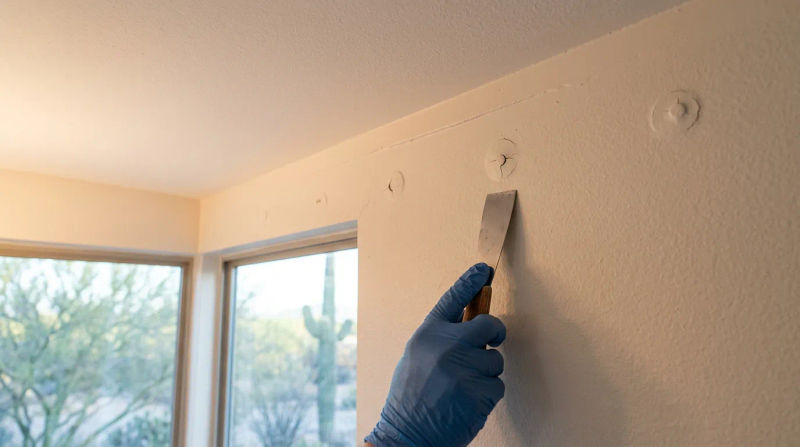
As an experienced project superintendent in the Tucson area, I’ve seen how our unique climate affects homes. You might be enjoying a cup of coffee one crisp October morning and notice something you hadn’t seen before: a series of small, perfectly round bumps or a faint ridge running along your wall. It’s a common experience for homeowners in Casas Adobes, especially as our warm days give way to colder, sometimes freezing, nights. These blemishes are often the first sign of drywall movement, and understanding what they mean is the first step toward a solution.
These cosmetic issues, while annoying, are typically not a cause for panic. They are a natural reaction of building materials to environmental changes. However, addressing them correctly is key to maintaining the pristine look of your home's interior.
Common Signs and Symptoms
Identifying drywall issues early can make repairs simpler and more effective. From my years in the field, I’ve learned to spot the subtle clues that homeowners often see. Here’s what to look for on your walls and ceilings:
- Drywall Nail Pops: These are the most common sign. They appear as small, circular bumps or cracked circles on the surface of your drywall. This happens when the head of a nail or screw pushes the outer layer of joint compound and paint outward. You can often feel them as raised dots when you run your hand over the wall.
- Raised or Ridged Seams: You might notice a long, faint, but perfectly straight ridge where two sheets of drywall meet. These raised drywall seams Casas Adobes homes sometimes exhibit are caused by the framing behind the wall shifting, pushing the taped seam slightly outward. They are most visible in certain lighting conditions, often along long, uninterrupted walls or ceilings, which are characteristic features of the single-story Ranch homes built in this area during the 1970s.
- Ceiling and Wall Corner Cracks: A fine crack appearing where the ceiling meets an interior wall can be related to truss uplift, a common occurrence in climates with significant temperature swings. The crack may seem to appear and disappear, getting wider in the winter and closing up in the summer.
- Fastener “Pops” After Cold Snaps: Pay close attention after a significant temperature drop. It’s common for drywall fastener pops after freezing nights to become much more apparent. The rapid cooling causes framing lumber to contract, making these blemishes appear almost overnight.
These symptoms are most frequently seen on the largest surfaces in your home, like vaulted ceilings or long hallway walls, where temperature and humidity variations have the greatest cumulative effect.
What Causes This Problem
While it’s easy to blame a poor drywall job, the root cause of these issues is almost always the natural behavior of the wood framing that makes up your home's skeleton. Our organized workflows and standardized building processes account for this movement, but in existing homes, especially those from the 1970s, these issues can develop over time.
Wood Framing and Humidity: Wood is a hygroscopic material, meaning it absorbs and releases moisture from the air. When it absorbs moisture during our humid monsoon season, it swells. When the air becomes dry and cold in the fall and winter, it releases that moisture and shrinks. This constant, subtle cycle of expansion and contraction is the primary driver of drywall nail pops.
A typical piece of framing lumber can shrink across its grain as it dries. While the drywall sheet itself is very stable, the wood stud it’s attached to is not. As the stud shrinks, it pulls away from the back of the drywall, but the fastener (the nail or screw) stays with the stud. This can leave a tiny gap. Over time, any slight pressure on the wall can push the drywall back against the fastener head, creating the “pop.”
Thermal Contraction in Casas Adobes: The effect is amplified by our desert climate. In Casas Adobes, a warm 75-degree October day can plummet to near-freezing temperatures overnight. This rapid temperature drop causes the wood framing in your attic and exterior walls to contract sharply. The drywall, which is on the climate-controlled interior side of the wall, doesn’t shrink as much. This differential movement is what makes fasteners pop and seams ridge.
Truss Uplift: For cracks at the ceiling line, the cause is often “truss uplift.” The bottom chords of your roof trusses are buried deep in warm ceiling insulation, while the top chords are exposed to the cold night air in the attic. The top chords contract in the cold, causing the entire truss to arch upward slightly in the middle. This lifts the ceiling drywall up and away from the interior wall partitions, creating that seasonal crack.
Building Era Context: Many homes in the Casas Adobes area are classic 1970s Ranch styles. While often built with durable slump block or brick exteriors, their interior partitions and roof systems are wood-framed. The open-concept layouts and long wall expanses popular in that era provide a large canvas where these subtle movements and resulting nail pops can be more noticeable.
When to Call a Professional
Deciding whether to tackle a repair yourself or call for help depends on the scope of the problem and your comfort level with drywall finishing.
A Potential DIY Fix: If you only have one or two isolated nail pops, you might consider a DIY repair. The basic process involves:
- Resetting the fastener: If it's a nail, drive it back in with a hammer and nail set. It's often better to drive a new drywall screw an inch or two above or below the popped nail to secure the drywall firmly to the stud. Then you can remove or countersink the old nail.
- Applying compound: Apply two or three thin coats of spackle or joint compound over the spot, letting each coat dry completely. Feather the edges to blend it with the surrounding wall.
- Sanding and Finishing: Lightly sand the final coat until it's perfectly smooth.
This brings up a common question: how to fix nail pops without repainting? Frankly, it is nearly impossible. Even if you have the original paint, the repaired patch will absorb the paint differently, and the sheen will not match. The color on your wall has also likely faded slightly over time. For a truly invisible repair, you will almost always need to prime the patch and repaint the entire wall from corner to corner.
When to Call for Professional Help: We recommend contacting an experienced professional if you encounter any of the following:
- Widespread Issues: If you have dozens of pops or ridged seams throughout your home, the job can become overwhelming. Our trained crews have the tools and standardized processes to perform these repairs efficiently and with minimal disruption.
- Recurring Problems: If you’ve fixed a pop and it keeps coming back, there may be an underlying issue that needs professional diagnosis.
- Tall Ceilings or Difficult Access: Working on ladders or scaffolding is best left to experienced technicians who are equipped with the proper safety gear.
- You Want a Perfect Finish: Drywall finishing is an art. Achieving a perfectly smooth, blended finish that is invisible after painting requires skill and experience. Our teams specialize in this level of quality control.
Conclusion
Seeing drywall nail pops and raised seams in your Casas Adobes home can be disheartening, but it's a common cosmetic issue driven by our local climate. These blemishes are the result of natural wood movement as temperatures and humidity levels change, especially during the transition into fall and winter. While a few minor spots can be a DIY project, achieving a flawless, lasting finish often requires professional expertise.
Acting early to correct these issues is always a good idea. It prevents a small cosmetic problem from becoming a major visual distraction and ensures your walls are in perfect condition before your next interior painting project. By understanding the cause, you can choose the right path to restore the smooth, beautiful surfaces of your home.
If you notice any of these signs, contact a local General Contractor professional for an inspection.